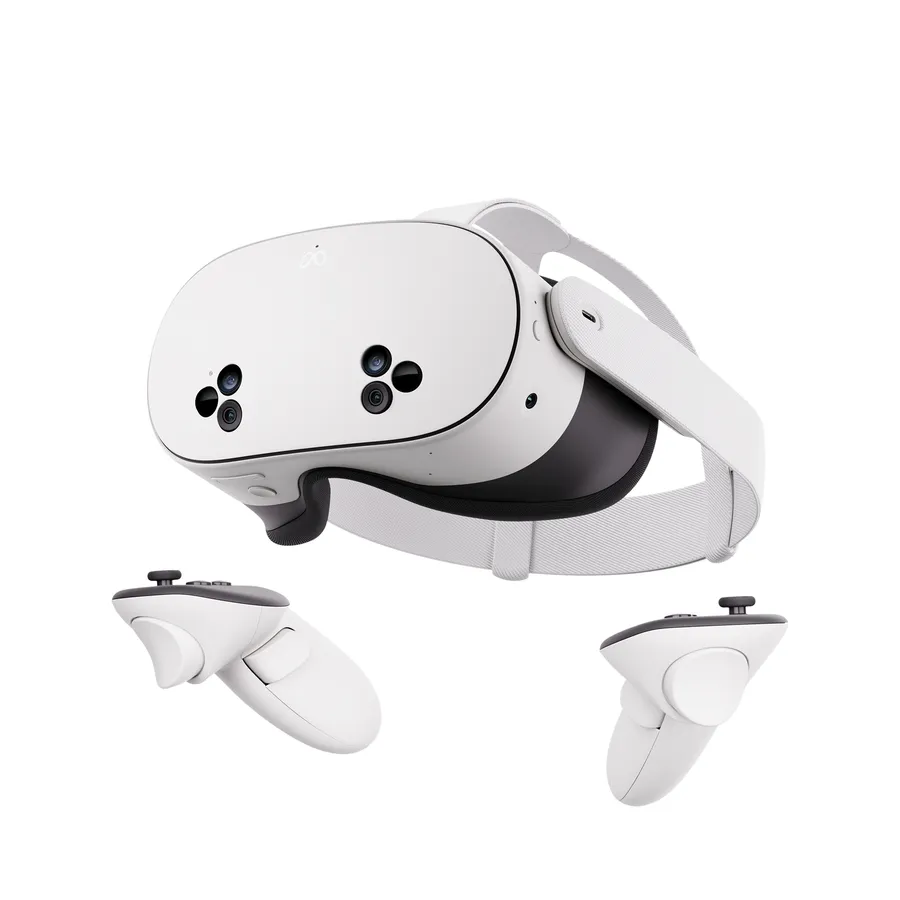
The budget Quest: same chip, Fresnel lenses.
- Quest store, SideQuest, PC
- LCD Fresnel
Buy the Quest 3 at $499 if this is your main headset: it has the pancake lenses, the sharpest panel of the three and every serious player app shipping there first. Buy the Quest 3S at $299 if budget rules - same chip and same app ecosystem, with noticeably blurrier Fresnel edges. The Quest 2 at $199 used is the secondhand workhorse: same panel class as the 3S, discontinued, and still the cheapest documented way into the ecosystem.
The budget Quest: same chip, Fresnel lenses.
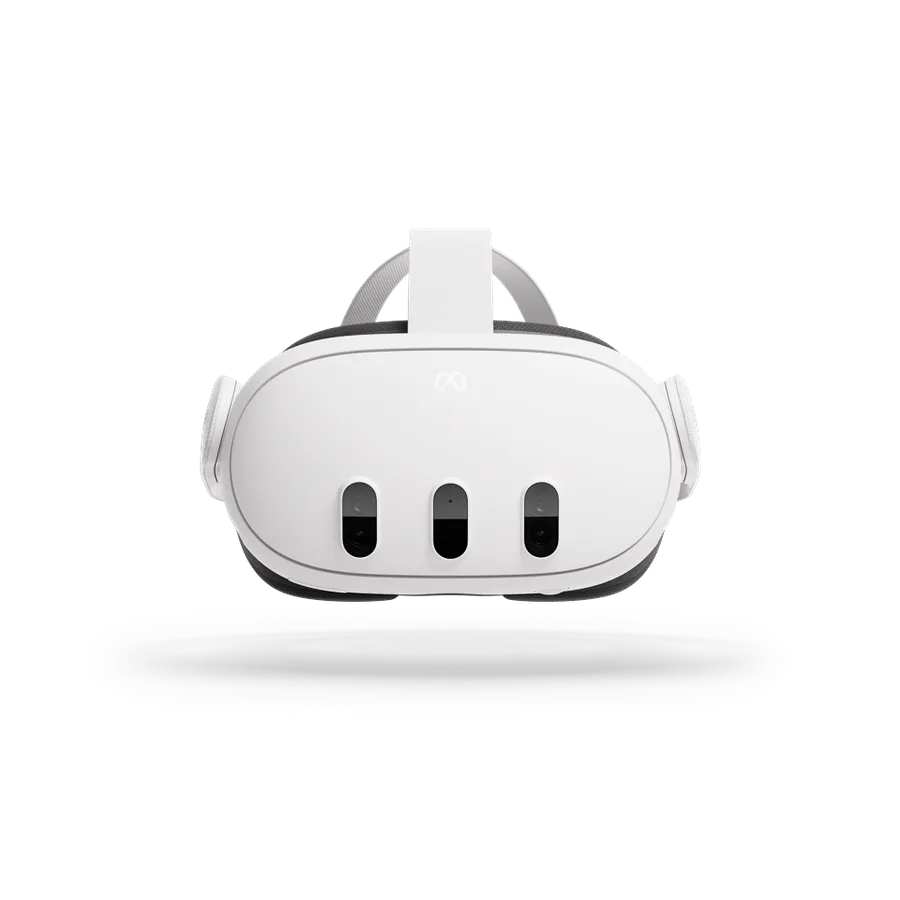
The adult-VR default: pancake clarity, best app support, passthrough.

The 2020 workhorse - discontinued but everywhere secondhand.
Buy the Quest 3 at $499 if this is your main headset: it has the pancake lenses, the sharpest panel of the three and every serious player app shipping there first. Buy the Quest 3S at $299 if budget rules - same chip and same app ecosystem, with noticeably blurrier Fresnel edges. The Quest 2 at $199 used is the secondhand workhorse: same panel class as the 3S, discontinued, and still the cheapest documented way into the ecosystem.
The Quest line is the default of adult VR for an unglamorous reason: it is where the player apps are. Every serious player ships for the Quest store first, the community tweak ecosystem is active, and the standalone design means no PC is required for everyday use. The catch is that "Quest" is now three headsets with a $300 spread between them - and the differences between them are exactly the differences that matter for this content. This board ranks all three, from external reviews, community threads and verified specs.
One generation chip, two lens types, three prices. The Quest 3 ($499) runs LCD pancake optics at 2064x2208 per eye - the sharpest documented panel of the line, with pancake lenses that keep text and detail sharp across the whole field of view. The Quest 3S ($299) pairs the same chip with Fresnel lenses at 1832x1920 - "noticeably blurrier edges than Quest 3" is the documented trade, and it is a lens artifact, not a chip one. The Quest 2 ($199, used) is the 2020 workhorse: discontinued but everywhere secondhand, with the same Fresnel panel class as the 3S.
Both 3-series headsets document the full platform spread - Quest store, SideQuest and PC - and the Quest 3 adds the widest PCVR bridge list: Link, Air Link or Steam Link, where the 3S and 2 document Link and Air Link.
3 headsets make up this board, priced from $199 used to $499 new. A note on the consensus numbers before the ranking: they average external reviews of the whole headset experience - setup, comfort, ecosystem - which is why a 6.5 can sit above a 5.7 without contradicting our ranking. The scores have counts attached for a reason.
| Product | Score | Price | Review | |
|---|---|---|---|---|
| Meta Quest 3 | 6.9 | $499 once | Review |
| Meta Quest 3S | 7.4 | $299 once | Review |
| Meta Quest 2 | 6.5 | $199 once (used) | Review |
The Quest 3 is our verdict's "safe default for VR porn in this generation", and the documented pros explain why in order: every serious player app runs here first, pancake lenses make text and detail sharp, and the community tweaks ecosystem is active. For this content specifically, two of its documented cons need managing: LCD blacks go grey in dark scenes (a panel property, covered honestly in our OLED hub), and the stock interface puts pressure on the face - which is why the verdict's advice is to pair it with a lens insert and a third-party strap. At $499 with a 5.7 consensus from 3 reviews, it is the pick we would make and the one the ecosystem assumes you made.
The Quest 3S ($299) is the same chip and the same app ecosystem as the Quest 3 at $200 less. Its single documented pro says it plainly - "same app ecosystem as Quest 3 at lower price" - and its single documented con is the entire difference: Fresnel lenses with noticeably blurrier edges. Its 6.5 consensus from 4 reviews is the highest documented on this board, and the honest reading of that number is that reviewers value the ecosystem at this price more than they penalize the lenses. For a first headset on a budget, or a second headset for another room, this is the rational buy.
<figure class="fig-diagram"><svg viewBox="0 0 734 340" role="img" aria-label="The Quest decision: budget and secondhand tolerance pick the model - the app ecosystem is the same on all three."> <defs> <marker id="dg-head" markerWidth="8" markerHeight="8" refX="6" refY="3" orient="auto"> <path d="M0,0 L6,3 L0,6 Z" fill="#ff4f8f"/> </marker> </defs> <text class="dg-h" x="24" y="40">The Quest decision</text>
<!-- start --> <rect class="dg-node-strong" x="292" y="60" width="150" height="44"/> <text class="dg-lbl" x="312" y="88">New Quest?</text>
<!-- level 1: budget --> <path class="dg-arrow" d="M316,104 L200,140"/> <path class="dg-arrow" d="M418,104 L534,140"/> <text class="dg-lbl-dim" x="210" y="124">budget first</text> <text class="dg-lbl-dim" x="470" y="124">no compromise</text>
<rect class="dg-node" x="90" y="144" width="200" height="56"/> <text class="dg-lbl" x="108" y="168">Under $300 new?</text> <text class="dg-lbl-2" x="108" y="188">Quest 3S - $299</text>
<rect class="dg-node" x="440" y="144" width="200" height="56"/> <text class="dg-lbl" x="458" y="168">Best panel in the line?</text> <text class="dg-lbl-2" x="458" y="188">Quest 3 - $499</text>
<!-- level 2 --> <path class="dg-arrow" d="M190,200 L130,236"/> <path class="dg-arrow" d="M190,200 L260,236"/> <text class="dg-lbl-dim" x="120" y="224">used ok</text> <text class="dg-lbl-dim" x="230" y="224">new only</text>
<rect class="dg-node-strong" x="60" y="240" width="200" height="56"/> <text class="dg-lbl" x="78" y="264">Quest 2 - $199 used</text> <text class="dg-lbl-2" x="78" y="284">watch stock, cheapest entry</text>
<rect class="dg-node" x="290" y="240" width="180" height="56"/> <text class="dg-lbl" x="308" y="264">Quest 3S - $299</text> <text class="dg-lbl-2" x="308" y="284">same chip, Fresnel edges</text>
<!-- outcome notes --> <rect class="dg-node" x="500" y="240" width="200" height="56"/> <text class="dg-lbl" x="518" y="264">Quest 3 - $499</text> <text class="dg-lbl-2" x="518" y="284">pancake, + lens insert, strap</text>
<text class="dg-lbl-dim" x="24" y="326">All three share the app ecosystem and PCVR bridges - the decision is price versus optics, nothing else.</text> </svg><figcaption>The Quest decision: budget and secondhand tolerance pick the model - the app ecosystem is the same on all three.</figcaption></figure>
The Quest 2 ($199, used) is discontinued and everywhere secondhand, with a 6 consensus from 3 reviews. It documents the same per-eye panel class as the 3S (1832x1920 Fresnel) and bridges to PCVR via Link or Air Link. We list it as watch stock rather than a recommendation - the headset is five generations of ecosystem behind on comfort and optics - but as the cheapest documented entry into the Quest ecosystem it remains on the board, and "Quest 2 now, Quest 3 later" is a defensible ladder for anyone testing whether this hobby sticks. Two practical notes from the documented specs: the used price is the number most likely to vary in your local market, and the Quest 2's spec sheet documents no platform list in our data - the store and SideQuest access it is known for belongs to its generation, not to our current verification.
All three document a bridge to PCVR, but the paths differ in ways worth spelling out. The Quest 3 documents the widest list - Link, Air Link or Steam Link - which matters because Steam Link is the bridge most commonly recommended when Meta's own tooling misbehaves. The Quest 3S and Quest 2 document Link and Air Link. None of the three needs a bridge for everyday standalone use; the bridge only enters when you want the headset to render what a gaming PC renders, at which point the Quest's per-eye panel - not the PC - is the ceiling. That is the honest summary of the Quest route into PCVR: cheapest bridge into the ecosystem, never the sharpest panel on it. Our PCVR hub ranks the native SteamVR alternatives with their base-station overhead.
The Quest line's two documented cons repeat across reviews because they are structural, not defects. LCD blacks read grey in dark scenes - every Quest on this board shares the panel family, and adult content lives disproportionately in dark scenes, which is why the OLED comparison hub exists and why we send readers there rather than pretending the number does not matter. Face pressure with the stock interface - the Quest 3's verdict names the fix concretely: a lens insert and a third-party strap. Neither fix is expensive relative to the headset; both change the experience enough that reviewers mention them unprompted. The Quest 2's secondhand pricing quietly assumes you will make these tweaks too - the used market's stock head straps have five more years of face time on them.
The Quest line's documented weakness - LCD grey-blacks in dark scenes - is precisely the property the two OLED headsets on our other boards sell: the Bigscreen Beyond 2's micro-OLED ("blacks transform dark scenes", 2560x2560 per eye, $1,599 plus base stations and a gaming PC) and the PSVR2 (OLED plus eye tracking, $399, but no native adult apps and a PC adapter that is documented as functional but limited). The trade in one line: the Quest ecosystem owns the player apps; the OLED panels own the dark-scene image. Most buyers should pick the ecosystem first - which is this hub's whole argument - and visit the OLED hub only when the panel question starts keeping them up at night.
Check the current price before buying - Meta's pricing moves with sales cycles - and read the full reviews: every claim here traces to a linked source with a checked date.