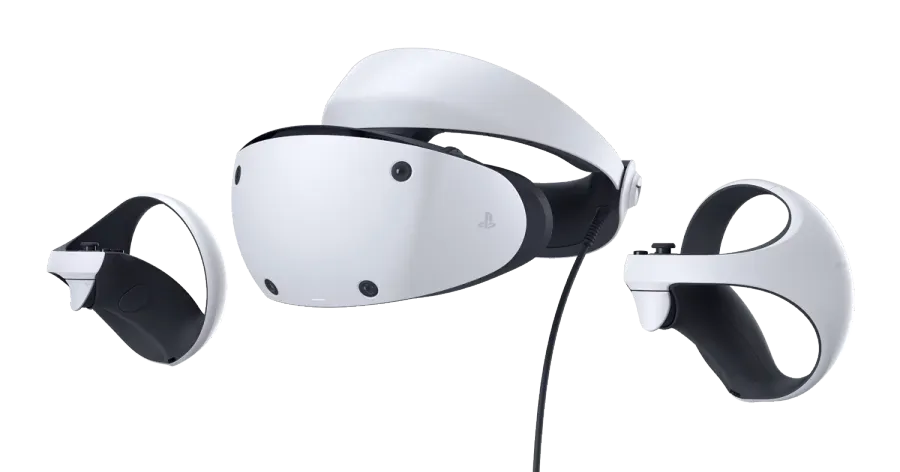
OLED and great lenses, but a locked ecosystem for adult use.
- PS5, PC (adapter)
- OLED
The Bigscreen Beyond 2 at $1,599 is the only OLED headset we recommend for adult VR: micro-OLED blacks that transform dark scenes, 2560x2560 per eye and 127 grams - at the cost of base stations, a gaming PC and the price. The PSVR2 at $399 has the same panel advantage but documents no native adult apps and only limited PC adapter support. The Apple Vision Pro is a display marvel at $3,499 with near-zero adult app support: watch-listed, not recommended.
OLED and great lenses, but a locked ecosystem for adult use.
Micro-OLED, 127 grams - the comfort king for PCVR.

Extraordinary displays, near-zero adult app support.
The Bigscreen Beyond 2 at $1,599 is the only OLED headset we recommend for adult VR: micro-OLED blacks that transform dark scenes, 2560x2560 per eye and 127 grams - at the cost of base stations, a gaming PC and the price. The PSVR2 at $399 has the same panel advantage but documents no native adult apps and only limited PC adapter support. The Apple Vision Pro is a display marvel at $3,499 with near-zero adult app support: watch-listed, not recommended.
Most VR content is shot in the dark, and most VR headsets cannot show the dark. LCD panels - the Quest 3 and Pico class - leave black scenes a shade of grey that reviewers keep writing into cons columns: the Quest 3's "LCD blacks are grey in dark scenes" is the single most consequential documented con in our headset boards. OLED is the display technology where pixels turn fully off, and on this board only three headsets ship it. This page ranks them - because the trade-offs between them are as sharp as the blacks themselves.
A quick note on why this hub exists at all, since no manufacturer markets to this use case. Dark scenes are the norm for adult content: dim rooms, low-key lighting, night settings. On an LCD panel, a "black" pixel is a backlit pixel with the shutter mostly closed - the viewer reads it as grey haze, and detail in shadows disappears into it. On OLED, the pixel is off. The difference is not a spec-sheet abstraction; it is the difference between watching the scene and watching it through fog. This is why the Bigscreen's documented pros lead with "OLED blacks transform dark scenes" - a sentence written about this exact use case without naming it.
3 headsets on this board document OLED or micro-OLED panels, priced from $399 to $3,499. What the numbers cannot show is how differently the three reach their panels: one through SteamVR, one through a console adapter, one through a walled garden. The consensus counts are small, and we show them with every score.
| Product | Score | Price | Review | |
|---|---|---|---|---|
| Bigscreen Beyond 2 | 4.9 | $1599 once | Review |
| PlayStation VR2 | 6.8 | $399 once | Review |
| Apple Vision Pro | 4.9 | $3499 once | Review |
The Beyond 2 ($1,599) is the OLED headset built for exactly this: micro-OLED pancake panels at 2560x2560 per eye, 127 grams - "lightest headset by far" per its pros - and native SteamVR over lighthouse tracking. Its two documented pros could serve as this page's thesis: "OLED blacks transform dark scenes" and "lightest headset by far". The cons are equally structural: it requires base stations and a gaming PC, it is PC only with no standalone mode, and the price is the highest of any headset we currently recommend. The consensus column is empty - no aggregated reviews yet - which we flag rather than round away. Buy it if the panel question is settled in your budget and your PC can carry it; check the PCVR hub for the pipeline details.
The PSVR2 ($399) documents the same headline property - OLED blacks - plus eye tracking, at the lowest price on this board. Everything else about it is friction for this use case: no native adult apps, and PC adapter support documented as "functional but limited". Its 6 consensus from 3 reviews reflects the whole package. The honest framing, which our PCVR hub uses too: the PSVR2 is a console purchase that can moonlight on PC, not a PCVR headset that happens to work on console. If you already own a PS5 and the adapter path does not deter you, the panel is genuinely the best dollar-for-black value in VR. If adult app support is the requirement, it is not the answer - no native apps means no native answer.
<figure class="fig-diagram"><svg viewBox="0 0 734 330" role="img" aria-label="The OLED field: panel, per-eye resolution, PCVR path and the catch - from the Beyond 2's open SteamVR route to the Vision Pro's walled garden."> <defs> <marker id="dg-head" markerWidth="8" markerHeight="8" refX="6" refY="3" orient="auto"> <path d="M0,0 L6,3 L0,6 Z" fill="#ff4f8f"/> </marker> </defs> <text class="dg-h" x="24" y="40">The OLED field: panel, path, catch</text>
<!-- three headsets as rows --> <rect class="dg-node-strong" x="24" y="64" width="686" height="70"/> <text class="dg-lbl" x="40" y="90">Bigscreen Beyond 2 - $1,599</text> <text class="dg-lbl-2" x="40" y="112">micro-OLED pancake, 2560x2560/eye, native SteamVR</text> <text class="dg-lbl-dim" x="40" y="130">catch: base stations + gaming PC, price - the recommendation anyway</text>
<rect class="dg-node" x="24" y="146" width="686" height="70"/> <text class="dg-lbl" x="40" y="172">PSVR2 - $399</text> <text class="dg-lbl-2" x="40" y="194">OLED, 2000x2040/eye, PC via official adapter + eye tracking</text> <text class="dg-lbl-dim" x="40" y="212">catch: no native adult apps, adapter "functional but limited"</text>
<rect class="dg-node" x="24" y="228" width="686" height="70"/> <text class="dg-lbl" x="40" y="254">Apple Vision Pro - $3,499 (watch)</text> <text class="dg-lbl-2" x="40" y="276">micro-OLED, 3660x3200/eye, no PCVR</text> <text class="dg-lbl-dim" x="40" y="294">catch: no native adult players, external battery, weight</text>
<!-- contrast line --> <path class="dg-arrow-2" d="M24,314 L710,314"/> <text class="dg-lbl-dim" x="24" y="322">LCD counterfactual: Quest 3 / Pico 4 Ultra - same pancake era, greyer blacks, the app ecosystems, half the price.</text> </svg><figcaption>The OLED field: panel, per-eye resolution, PCVR path and the catch - from the Beyond 2's open SteamVR route to the Vision Pro's walled garden.</figcaption></figure>
The Vision Pro ($3,499, watch-listed) documents the most extraordinary display on any board we run: micro-OLED at 3660x3200 per eye. Its documented cons are everything else: no native adult players, an external battery, and a design whose weight lands with the battery pack. The consensus sits at 5.5 from 3 reviews. We list it because readers ask - the panel is the state of the art, and pretending otherwise would be its own kind of dishonesty - but watch-listed means what it says: we do not recommend a $3,499 display wrapper around an ecosystem with near-zero adult app support.
The three panels on this board are not interchangeable OLEDs, and the spec strings document the differences. The Beyond 2 runs micro-OLED pancake at 2560x2560 per eye - the pancake optics matter as much as the emitter, keeping the whole 2560-square field sharp in a 127-gram shell. The PSVR2 runs OLED at 2000x2040 per eye with "great lenses" per its tagline and eye tracking documented as a pro - a 2022-era panel spec that still beats every LCD on black level. The Vision Pro runs micro-OLED at 3660x3200 per eye, the highest pixel count on any board we run. Per-eye resolution between the Beyond 2 and the PSVR2 differs by about 25 percent in each direction; the black-level advantage they share is the reason both are on this hub at all.
The evidence behind this board is thinner than any other hub on the site, and readers deserve that in writing. The Beyond 2 has no aggregated consensus at all - a new headset from a boutique manufacturer whose review coverage has not accumulated in our sources yet. The PSVR2 rests on 3 reviews averaging 6, the Vision Pro on 3 reviews averaging 5.5. None of these numbers is wrong; all of them are small. Where a review page exists, we link the individual sources - and where a verdict contradicts a low consensus (the Beyond 2's), the reasoning is in the specs and pros, not in the missing score.
Two of the three OLED headsets carry documented ergonomics notes that matter more in long sessions than on a spec sheet. The Beyond 2's 127 grams make it "the lightest headset by far" on our boards - its design moves the compute to the PC and wears like a pair of goggles rather than a helmet. The Vision Pro's external battery and weight are documented cons - a headset whose display you admire and whose evenings you schedule around. The PSVR2 documents neither advantage nor burden here; its ergonomics live in the individual reviews rather than in our spec fields, and we leave it at that rather than guess.
For contrast, the headsets this hub excludes: the Quest 3 ($499) and Pico 4 Ultra ($549) run LCD pancake panels at 2064x2208 and 2160x2160 - greyer blacks, the app ecosystems, half the price. The Pimax Crystal Light ($699) runs QLED at 2880x2880, native SteamVR - sharper than any OLED here per eye, without OLED's black level. The full comparison lives in our PCVR hub. The one-line version for buyers torn between panels: the Beyond 2 is what you buy when dark-scene rendering is the spec you cannot compromise, and the Quest 3 is what you buy when the ecosystem is.
Check the current price before buying, and read the full reviews: every claim here traces to a linked source with a checked date, and OLED stock situations are the most volatile in this vertical.