
The FeelStars workhorse with a mature app ecosystem.
- Bluetooth + app
- via app
- low-moderate
The Handy is the default for script playback thanks to Wi-Fi sync and the largest script ecosystem; the Lovense Solace Pro is the quiet consensus pick, and the OSR2/SR6 builds beat everything on stroke fidelity if you are willing to assemble parts. Start with The Handy if you want the shortest path from download to play.
The FeelStars workhorse with a mature app ecosystem.
Air-pump + vibration stroker woven into the Lovense app world.
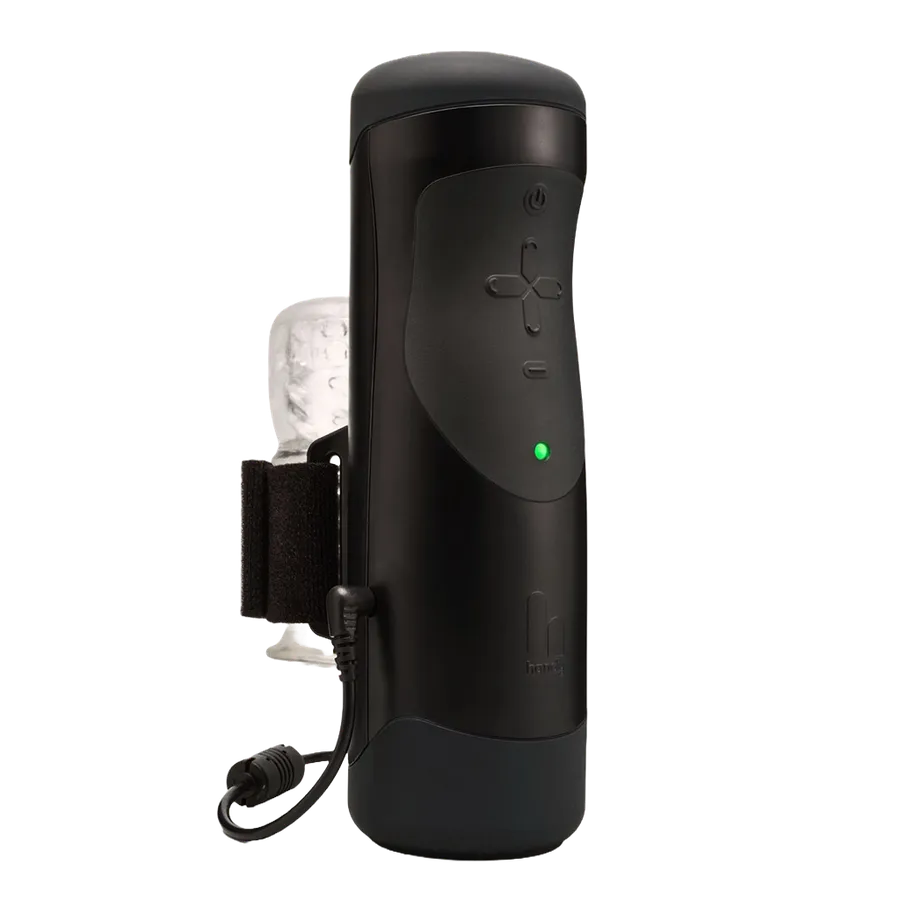
The scripting benchmark: fast, precise stroke length, huge script library.
Depth-sensing suction stroker with squeeze control.
Automatic stroking with deep app control and scripting.

Budget app-controlled stroker that plays nice with third-party tools.

Vibrating-texture stroker with Feel content support.

Contracting-ring stroker, the older Keon sibling.
The DIY open-source servo stroker behind the serious script community.
Six-axis evolution of the OSR platform: linear stroke plus tilt and twist.
The Handy is the default for script playback thanks to Wi-Fi sync and the largest script ecosystem; the Lovense Solace Pro is the quiet consensus pick, and the OSR2/SR6 builds beat everything on stroke fidelity if you are willing to assemble parts. Start with The Handy if you want the shortest path from download to play.
A funscript stroker turns a passive video into something the room can hear. The scripts themselves are free and community-made, the players are free - the toy is the only purchase, and it is the part worth comparing. This board ranks every stroker on file that ships with funscript support, scored from external reviews, owner threads and verified specs.
Three layers have to cooperate: the script (a .funscript file with movement timestamps), the player (a desktop or mobile app that reads the script and sends commands), and the toy (a stroker that executes the motion). Any break in the chain - a toy without Wi-Fi, a player without toy support - and you are back to manual mode.
<figure class="fig-diagram"><svg viewBox="0 0 734 300" role="img" aria-label="The funscript chain: script file, player and toy - a break anywhere means manual playback."> <defs> <marker id="dg-head" markerWidth="8" markerHeight="8" refX="6" refY="3" orient="auto"> <path d="M0,0 L6,3 L0,6 Z" fill="#ff4f8f"/> </marker> </defs> <text class="dg-h" x="24" y="40">The funscript chain</text> <rect class="dg-node" x="24" y="80" width="200" height="120"/> <text class="dg-lbl" x="44" y="118">1. Script file</text> <text class="dg-lbl-2" x="44" y="142">.funscript with</text> <text class="dg-lbl-2" x="44" y="162">motion timestamps</text> <text class="dg-lbl-dim" x="44" y="186">community-made, free</text>
<path class="dg-arrow" d="M224,140 L280,140"/>
<rect class="dg-node" x="284" y="80" width="200" height="120"/> <text class="dg-lbl" x="304" y="118">2. Player</text> <text class="dg-lbl-2" x="304" y="142">desktop / mobile app</text> <text class="dg-lbl-2" x="304" y="162">reads script, sends</text> <text class="dg-lbl-2" x="304" y="182">commands</text>
<path class="dg-arrow" d="M484,140 L540,140"/>
<rect class="dg-node-strong" x="544" y="80" width="166" height="120"/> <text class="dg-lbl" x="564" y="118">3. Toy</text> <text class="dg-lbl-2" x="564" y="142">executes motion:</text> <text class="dg-lbl-2" x="564" y="162">stroke, rotate,</text> <text class="dg-lbl-2" x="564" y="182">contract</text>
<text class="dg-lbl-dim" x="24" y="242">A break anywhere in the chain (no Wi-Fi, no player support, wrong firmware)</text> <text class="dg-lbl-dim" x="24" y="264">means manual playback - the script simply does nothing.</text> </svg><figcaption>The funscript chain: script file, player and toy - a break anywhere means manual playback.</figcaption></figure>
The practical differences between toys sit in two places: how the motion is produced (a rotating motor case like the Keon, a linear servo like The Handy, contracting rings like the Onyx+), and how it connects (Bluetooth, Wi-Fi, or a USB serial link for the DIY builds). Motion style changes the sensation more than the marketing suggests: stroke length and speed ceiling are the two specs that separate the field.
Scripts are community labour: volunteers run scene files through generator tools, then hand-tune the output on forums like EroScripts. That ecosystem is why The Handy and the Lovense lines dominate this board - their owners are the people writing and sharing the scripts. When a toy's community is small, the script supply dries up first, even if the hardware is fine. Before you buy, check which ecosystem your toy feeds: 10 devices on this board support funscripts, but they split across three control stacks - Kiiroo's FeelConnect, Lovense's Remote app, and the open Buttplug.io/Intiface route that the DIY builds and most desktop players speak.
The stack decision is the real purchase decision. A Wi-Fi toy like The Handy can fetch scripts directly, so your phone stays free. Bluetooth toys need an app running as a bridge, which costs a little latency but adds partner features - the Lovense toys excel there. The USB-serial DIY builds skip bridges entirely and give players like HereSphere direct, low-latency control, which is why the script fidelity ceiling on this board belongs to hardware you assemble yourself.
10 of the 10 products on this board carry a full score, and the setups differ more than the prices. The Onyx+ and Calor are the closest to plug-and-play: pair, open a script in the vendor app, done. The Handy adds a Wi-Fi pairing step and rewards a mount immediately - community threads agree hands-free is the intended way to use it. The Solace Pro ships its desk mount in the box, which says something about how it is meant to be used. The OSR2 and SR6 are weekend projects: printing, servo calibration, firmware. None of this is documented as "hard", but budget realistic time - the reviews on file for each product carry the specifics.
10 strokers on this board support funscripts; 10 of them carry a full meta-review score. Prices run from $109 to about $400 in parts. The consensus leader on the documented evidence is Kiiroo Keon at 8.9/10.
| Product | Score | Price | Review | |
|---|---|---|---|---|
| The Handy | 8.2 | $139 once | Review |
| Lovense Solace Pro | 7.9 | $299 once | Review |
| Kiiroo Keon | 8.9 | $199 once | Review |
| Lovense Max 2 | 8.3 | $129 once | Review |
| Kiiroo Onyx+ | 6.5 | $159 once | Review |
The Handy is "the most connected automatic stroker on the market and the default choice for script/VR sync" in our verdict - the ecosystem, not just the hardware, is the product. Wi-Fi means it can pull scripts straight from a URL, the stroke adjustment is fast and precise, and the community tooling around it is the largest of any device on this board. The trade-offs owners name most: it needs a mount for hands-free use, and the noise is mechanical rather than quiet. At $199 it is also not the cheapest entry, though frequent discount codes close the gap.
Reviewer after reviewer and countless community threads name the Solace Pro the automatic stroker worth keeping - it is the closest thing the category has to a consensus pick, and it scores 8.9-tier on our board at 8.5. The clamp-style desk mount ships in the box, the app adds AI Sync for porn and positional partner sync, and the noise level is manageable for shared apartments. Caveats from the documentation: the deepest sync features are mobile-only, and long-term value depends on Lovense's own store, which has shown availability gaps.
The Keon pairs a motorized case with Kiiroo's FeelStars sleeve line - sleeves are sold separately, which matters for the total cost of ownership. Long-term owners rate it highly, the FeelMe AI integration extends sync to many adult sites, and at $159 it undercuts The Handy. Our review's honest advice: budget for a sleeve and a mount, and if you can wait for a sale, wait.
The Lovense Max 2 ($199) is the value play if you want app and couple-sync features more than automated stroking - it is a vibrating air-pump toy, not a milking machine, and community reports call it the quietest of the popular interactive strokers. The Kiiroo Onyx+ ($109, heavily discounted) is the gentle ring-stroker with superb edging and quiet operation, though it is sold out at Kiiroo's own store. The Lovense Calor ($139) is the discreet, waterproof, travel-friendly option whose depth-sensing squeeze control is genuinely different - community opinion splits on sensation strength. The Kiiroo Titan is a legacy pick: still liked by vibration lovers, but no longer sold by Kiiroo and outclassed by current automatics.
The OSR2/OSR2+ and SR6 are open-source, 3D-printed servo builds driven by TCode firmware through Intiface Central or XToys. They deliver unmatched stroke performance and script fidelity - multi-axis motion no commercial toy matches - and they are consistently described as "more a tech project than a stroker." Expect to spend a weekend assembling, tuning and printing parts; expect noise; expect the best sync fidelity on this board as the reward. At roughly $180 (OSR2) to $400 (SR6) in parts, they are cheaper than they look - if your time is free.
<figure class="fig-diagram"><svg viewBox="0 0 734 340" role="img" aria-label="Where the board lands: noise versus script fidelity. DIY builds win fidelity and lose on noise and effort."> <defs> <marker id="dg-head" markerWidth="8" markerHeight="8" refX="6" refY="3" orient="auto"> <path d="M0,0 L6,3 L0,6 Z" fill="#ff4f8f"/> </marker> </defs> <text class="dg-h" x="24" y="40">Noise vs script fidelity</text>
<!-- axes --> <path class="dg-line" d="M70,50 L70,290"/> <path class="dg-line" d="M70,290 L700,290"/> <text class="dg-lbl-dim" x="24" y="170" transform="rotate(-90 24 170)">script fidelity →</text> <text class="dg-lbl-dim" x="400" y="315">noise level →</text>
<rect class="dg-band" x="70" y="70" width="630" height="40"/>
<!-- products: x = noise, y = fidelity (higher = lower y) --> <circle class="dg-node-strong" cx="200" cy="100" r="7"/> <text class="dg-lbl-2" x="212" y="96">SR6 (DIY)</text> <circle class="dg-node-strong" cx="240" cy="115" r="7"/> <text class="dg-lbl-2" x="252" y="111">OSR2+ (DIY)</text> <circle class="dg-node-strong" cx="360" cy="130" r="7"/> <text class="dg-lbl-2" x="372" y="126">The Handy</text> <circle class="dg-node-strong" cx="330" cy="150" r="7"/> <text class="dg-lbl-2" x="342" y="146">Solace Pro</text> <circle class="dg-node-strong" cx="390" cy="185" r="7"/> <text class="dg-lbl-2" x="402" y="181">Keon</text> <circle class="dg-node-strong" cx="250" cy="240" r="7"/> <text class="dg-lbl-2" x="262" y="236">Max 2 (quietest)</text> <circle class="dg-node-strong" cx="210" cy="255" r="7"/> <text class="dg-lbl-2" x="222" y="251">Onyx+ (rings)</text> <circle class="dg-node-strong" cx="290" cy="225" r="7"/> <text class="dg-lbl-2" x="302" y="221">Calor</text>
<text class="dg-lbl-dim" x="470" y="86">band = best trade-off</text> </svg><figcaption>Where the board lands: noise versus script fidelity. DIY builds win fidelity and lose on noise and effort.</figcaption></figure>
Whichever you pick, read the full review before buying: every claim on this page traces to a linked source, and the review pages carry the checked date for prices and availability.
One last buying note: this board ranks hardware, not scripts. The same stroker can feel brilliant with a well-tuned script and dull with a lazy one, so the community ecosystem around your pick - script supply, player support, mount options - is worth as much as the motor. That is also why the boards rank sync and build separately: check the dimension bars on each review page before you commit.